
Lamar County Criminal Court Records
Lamar County criminal court records are kept by the Clerk of Superior Court at the courthouse in Barnesville. This West Central Georgia county handles felony and misdemeanor cases through its Superior Court and State Court. Caleb Tyson serves as the Clerk of Superior Court and manages all court filings in the county. You can search criminal case files by visiting the clerk office on Thomaston Street or by using Georgia's statewide online tools. Staff at the clerk office can pull case records, look up court dates, and provide copies of criminal filings during normal business hours. Lamar County is part of a judicial circuit that covers several counties in the region, and all criminal matters from within the county go through the Barnesville courthouse.
Lamar County Criminal Records Quick Facts
Lamar County Court Clerk Office
Caleb Tyson is the Clerk of Superior Court in Lamar County. His office handles all criminal court records that pass through the county courts. The Lamar County Courthouse is at 326 Thomaston St. in Barnesville. You can call (770) 358-5145 to ask about a criminal case or check on a court date. The fax line is (770) 358-5814. This is where criminal case files are stored, court dates are managed, and copies of records are made for the public. Staff can help with most requests the same day you visit or call.
The GSCCCA page for Lamar County has the clerk contact information and links to filing records for this county.
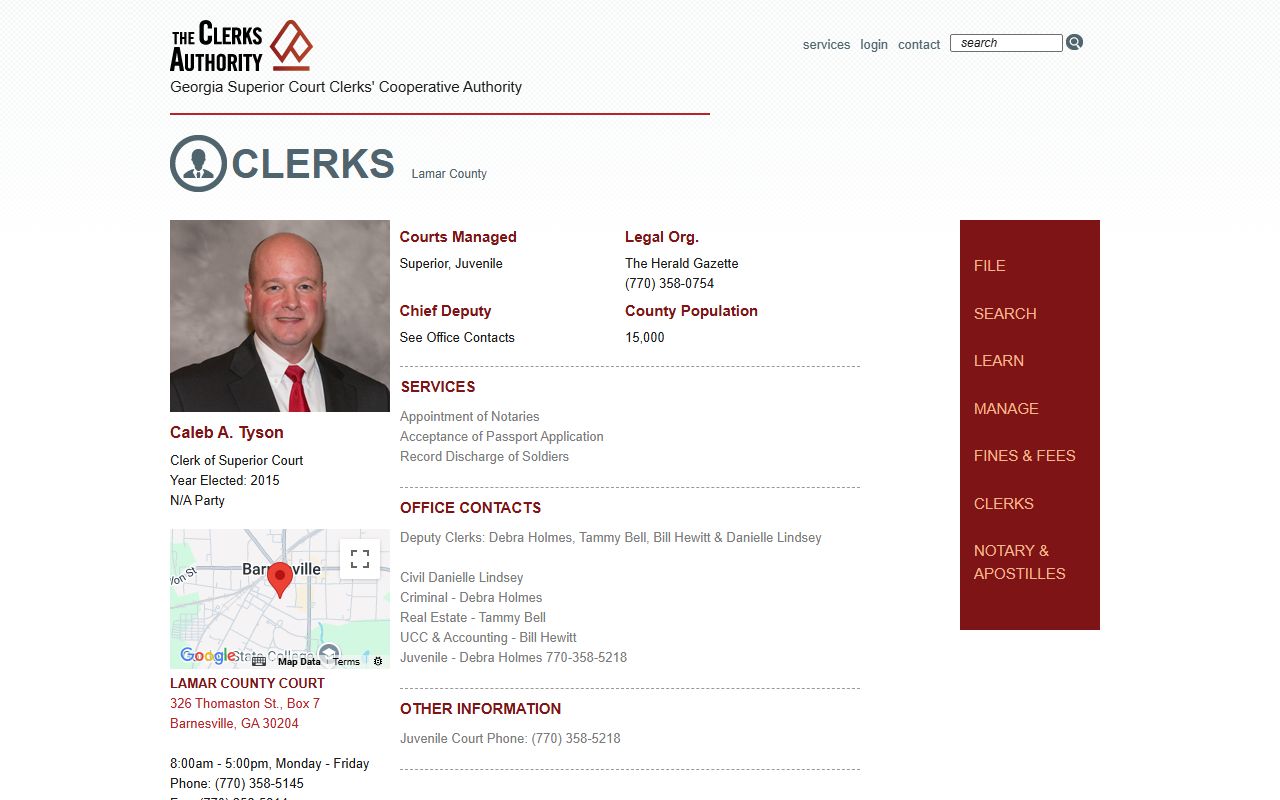
From this page, you can find the Lamar County clerk phone number, address, and links to county filing data in the GSCCCA system.
| Superior Court Clerk |
326 Thomaston St. Barnesville, GA 30204 Phone: (770) 358-5145 Fax: (770) 358-5814 |
|---|---|
| Office Hours | Monday through Friday, 8:00 AM - 5:00 PM |
| Clerk Name | Caleb Tyson |
Note: Bring a valid photo ID if you plan to visit the Lamar County clerk office in person for criminal records.
Searching Lamar County Criminal Records
There are a few ways to search for criminal court records in Lamar County. Going to the clerk office in Barnesville is the most direct option. Staff can look up cases by name or case number and print copies for you while you wait. Copy fees in Georgia are $0.10 per page under O.C.G.A. § 50-18-71. The first 15 minutes of staff search time are free. Most basic lookups take less than that, so there is rarely an extra charge beyond the per-page copy fee. If you cannot make the trip, you can mail a request to the courthouse at 326 Thomaston St., Barnesville, GA 30204.
Under O.C.G.A. § 50-18-70, criminal court records in Georgia are public. Anyone can ask to see them. No reason is needed. The Lamar County clerk must respond within three business days. This is the same across all 159 counties. You can request records by phone, in person, or by mail. Include the person's full name and any case details to help staff find what you need faster.
Criminal Cases in Lamar County
Lamar County Superior Court takes felony criminal cases. Violent crimes, drug trafficking, burglary, and other serious offenses go through Superior Court. State Court handles misdemeanor cases like simple assault, DUI, minor drug charges, and criminal traffic violations. Magistrate Court in Lamar County deals with preliminary hearings and bond settings for criminal matters. Each of these courts creates records that the Lamar County Clerk stores at the Barnesville courthouse.
Criminal cases in Lamar County follow the standard Georgia process. An arrest starts everything. Charges get filed, and the case moves through the system. Records are made at each step along the way. Under O.C.G.A. § 50-18-72, some records may be kept from public view during active investigations. When the case ends, most of the file becomes public. Basic docket info and court dates are usually available even for cases that are still open. Lamar County is a smaller county, so the volume of criminal filings is lower than metro areas, but the same state laws and procedures apply.
Under O.C.G.A. § 35-3-34, attorneys can request criminal history records from the Georgia Crime Information Center by submitting a written request with case details. Defense lawyers in Lamar County use this process to prepare for trial. The records include arrest data, charges, and final case outcomes.
Note: Records from sealed or juvenile cases in Lamar County are not available to the public.
Lamar County Records Online
Lamar County does not have its own online court records search. For online access, statewide tools are the best option. The Georgia Superior Court Clerks' Cooperative Authority indexes filings from all 159 counties. GSCCCA mainly handles real estate and lien records, but it can point you to the right clerk for criminal data. A regular account is $14.95 per month. Premium access runs $29.95. The E-Access to Court Records portal also lets you look up case data from courts across Georgia.
For your own criminal history, visit the Lamar County Sheriff's Office and ask for a Purpose Code U report. The GBI Criminal History page explains the statewide process. Call (404) 244-2639 option 3 for the GBI helpline. Under O.C.G.A. § 35-3-37, certain criminal records can be restricted from public view. Arrests without convictions may qualify. Some misdemeanor convictions become eligible after four years. Lamar County residents start the process through the DA's office for arrests on or after July 1, 2013. The fee is up to $50, and processing takes two weeks to 90 days.
Cities in Lamar County
All criminal cases from cities and towns in Lamar County go through the Superior Court or State Court in Barnesville. The courthouse on Thomaston Street is the main location for felony and misdemeanor filings from across the county.
Cities and towns in Lamar County include Barnesville, Milner, and Aldora. Criminal cases from all of these areas are processed through the Lamar County court system.
Nearby Counties
These counties border Lamar County. If you are not sure which county handles a criminal case, check the address where the arrest took place. Criminal cases must be filed in the county where the alleged crime occurred.