
Floyd County Criminal Court Records
Floyd County criminal court records are managed by the Clerk of Superior Court at 3 Government Plaza in Rome. The clerk's office keeps files on all felony and misdemeanor cases that move through the Floyd County court system. You can search criminal court records by case number, party name, or CSE number through an online portal, or visit the courthouse in person. Staff in the criminal division can pull case files and give you copies of court documents. The Rome Judicial Circuit covers Floyd County, and the Superior Court handles all felony matters. The courthouse sits at the center of the county seat and serves as the main point of access for anyone who needs to look up a criminal case.
Floyd County Criminal Records Quick Facts
Floyd County Court Clerk Office
The Clerk of Superior Court runs the criminal records office in Floyd County. The main office is at 3 Government Plaza, Suite 101, in Rome. This is where all felony case files are stored and managed. Walk in during business hours and the staff can search for a case by name or number. You can also call (706) 291-5190 to ask about a case or get info on how to request copies. The fax line is (706) 233-0035 if you need to send a written request. Chief Deputy Clerk Tina Holderfield helps run day-to-day work at the office. Four criminal clerks handle case processing: Janet Langston, Carolyn Dillard, Tina Holderfield, and Bethany Blalock. Each clerk deals with different parts of the criminal case flow, from new filings to final court orders.
The GSCCCA page for Floyd County lists clerk contact info and links to real estate and lien search tools for the county.
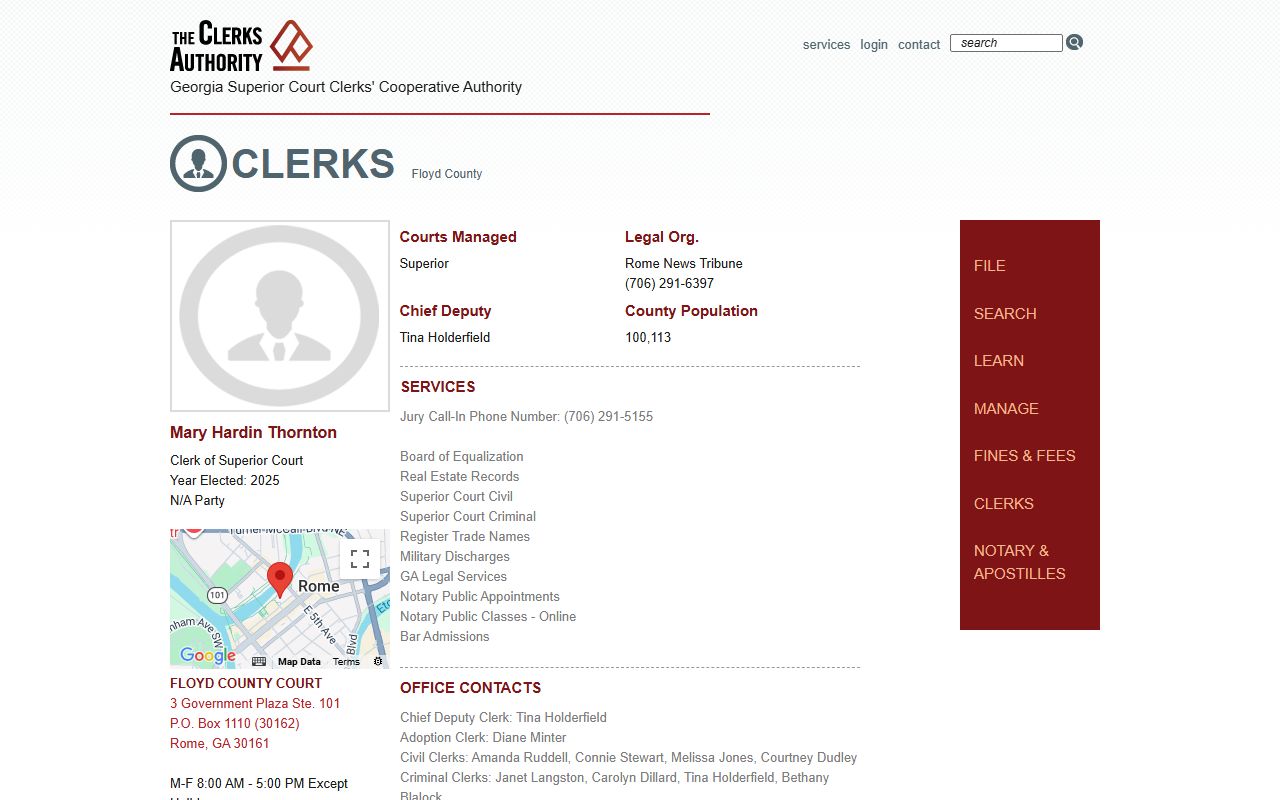
From this page you can find the clerk address, phone, and links to other Floyd County filing tools. The GSCCCA indexes documents from all 159 Georgia counties, and the Floyd County entry connects you to the local clerk for criminal and civil case data.
| Clerk of Superior Court |
3 Government Plaza, Suite 101 P.O. Box 1110, Rome, GA 30162 Phone: (706) 291-5190 Fax: (706) 233-0035 |
|---|---|
| Chief Deputy Clerk | Tina Holderfield |
| Criminal Clerks | Janet Langston, Carolyn Dillard, Tina Holderfield, Bethany Blalock |
| Jury Call-In | (706) 291-5155 |
Note: Bring a valid photo ID when you visit the Floyd County Clerk's office to request criminal court records in person.
Searching Floyd County Criminal Records
There are a few ways to search for criminal court records in Floyd County. The fastest is the online case search portal. You can look up cases by case number, party name, or CSE number. Pick "Criminal Record" from the search type to narrow your results. The portal shows case status, charges, and court dates. You do not need an account to run a basic search. If the online tool does not have what you need, call the clerk's office or go to 3 Government Plaza in Rome. Staff at the front desk will pull files for you.
The statewide E-Access to Court Records portal is another way to look up criminal cases in Floyd County and other Georgia counties.
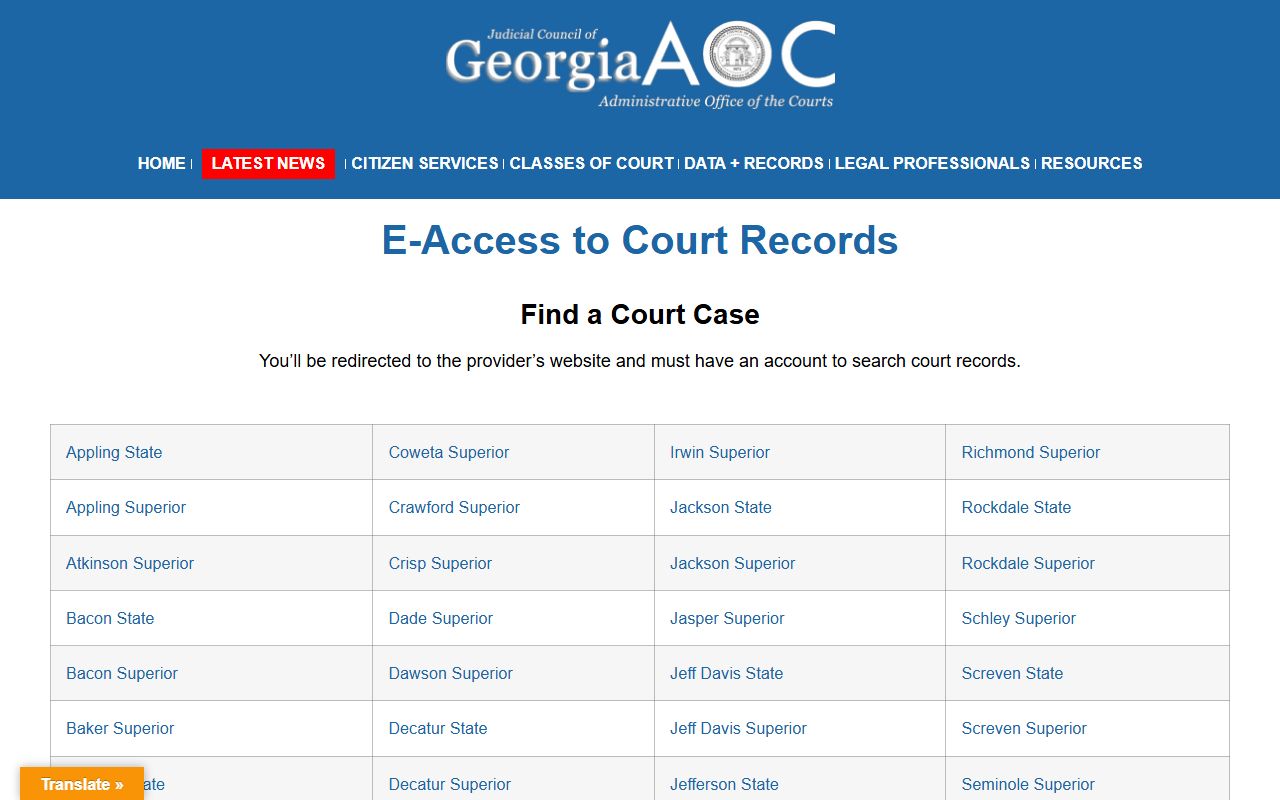
E-Access connects to the PeachCourt system and lets you search case data from counties across Georgia, including Floyd County. You will need an account to use it. Once logged in, you can check case status, view filed documents, and find court dates. Under O.C.G.A. § 50-18-70, criminal court records in Georgia are public. Anyone can ask to see them. You do not have to give a reason. The agency has three business days to respond to your request. Copy fees run $0.10 per page for standard copies, and the first 15 minutes of search time are free under O.C.G.A. § 50-18-71.
To search criminal records in Floyd County, you will want:
- Full name of the person you are looking for
- Date of birth or approximate age
- Case number if you have one
- Type of case (felony or misdemeanor)
- CSE number for child support enforcement cases
Floyd County Courts and Case Types
Floyd County has four court divisions that deal with different types of criminal matters. The Superior Court at 3 Government Plaza, Suite 101 handles all felony cases. These include drug charges, violent crimes, theft over a set dollar amount, and other serious offenses. You can reach the Superior Court at (706) 291-5190. Magistrate Court sits in Suite 227 of the same building and handles preliminary hearings, bond matters, and warrants. That court's number is (706) 291-5250. Each of these courts creates criminal court records that go into the Floyd County clerk files.
Juvenile Court is in Suite 202 at the same address. Call (706) 291-5180 for that court. Probate Court is in Suite 201 and can be reached at (706) 291-5136. While Probate Court does not handle standard criminal cases, it deals with matters that sometimes tie into criminal records, like weapons permits and certain mental health hearings. All four courts sit in the same building, which makes it simple to go from one division to another if you need records from more than one court.
Under O.C.G.A. § 35-3-37, some criminal records in Georgia can be restricted from public view. This used to be called expungement. It covers arrests that did not lead to a conviction, certain misdemeanor convictions after a four-year wait, and cases placed on a dead docket for more than 12 months. Floyd County residents can start this process through the District Attorney's office for arrests on or after July 1, 2013. For arrests before that date, contact the arresting law enforcement agency.
Floyd County Criminal Case Resources
The Floyd County Sheriff's Office is another place to access criminal records. The sheriff is at 3 Government Plaza, #110, in Rome. Call (706) 291-4111 to reach them. The sheriff handles warrants, arrests, and inmate transport in Floyd County. You can request your own criminal history through the sheriff's office by asking for a "Purpose Code U" report. This is the standard way to get your Georgia criminal history for personal use. The sheriff's office may charge a small fee for this service.
The GBI Criminal History page is useful if you need statewide records or want to check on the status of a record restriction. The Georgia Crime Information Center also maintains criminal records. You can call (404) 244-2639 option 1 to set up an appointment for record inspection at the GBI office. Under O.C.G.A. § 35-3-34, GCIC can share criminal history data with attorneys who submit a written request that includes case details and subject info. Defense lawyers in Floyd County use this path when they prep for trial.
The GBI Open Records Unit no longer takes requests by email as of December 2023. Use their online portal or mail your request to P.O. Box 370808, Decatur, GA 30037-0808. Agencies in Georgia may charge up to $50 to process a criminal record restriction request.
Note: The GCIC lobby is open by appointment only for record inspections and fingerprint services.
Floyd County Record Fees and Copies
The Floyd County Clerk charges standard fees for copies of criminal court records. Georgia law sets the base rate at $0.10 per page for standard copies. The first 15 minutes of staff search time are free. After that, the clerk can charge a prorated hourly rate based on the lowest paid qualified employee who can fill your request. Contact the Floyd County Clerk at (706) 291-5190 for the current fee schedule, since some fees may vary by document type.
The Georgia Superior Court Clerks' Cooperative Authority offers another way to search Floyd County records online. A regular GSCCCA account costs $14.95 per month. Premium access runs $29.95 per month. While GSCCCA focuses on real estate and lien records, it can help you find the right filing or point you to the correct clerk for criminal case files. The FANS system is a free tool that lets you monitor new filings related to your name across all 159 Georgia counties.
Record restriction in Floyd County follows state rules. Certain misdemeanor convictions may qualify for restriction after four years have passed since the end of your sentence. You must have no other convictions during that time. Serious violent felonies and sex offenses are not eligible. There is a lifetime cap of two record restrictions for misdemeanor convictions. Victims of trafficking may be eligible for free record restriction under the Debbie Vance Act, codified at O.C.G.A. § 17-10-21.
Online Tools for Floyd County Records
Several statewide tools can help you find criminal court records in Floyd County from home. The Georgia Courts website is a good starting point. It links to court directories, E-Access, and other judicial resources. The Supreme Court of Georgia Docket Search covers appellate cases from the last five years, which may include appeals from Floyd County criminal convictions.
For your own criminal history, visit the Floyd County Sheriff's Office or a local police department in Rome. Ask for a Purpose Code U report. The GBI Criminal History Records Helpline at (404) 244-2639 option 3 can answer questions about your statewide record, including cases that started in Floyd County. Time-expired restrictions may still show on FBI or out-of-state background checks. For full restriction, follow the formal application process through the DA or the arresting agency.
Cities in Floyd County
Floyd County is in northwest Georgia with Rome as its county seat. All criminal cases from cities in the county go through the Floyd County Superior Court system. The courthouse at 3 Government Plaza handles felony cases, while the Magistrate Court in the same building deals with preliminary hearings and bond matters.
Other towns in Floyd County include Cave Spring, Shannon, and Lindale. Criminal cases from these areas are handled by the Floyd County court system as well.
Nearby Counties
These counties border Floyd County. If you are not sure which county handles a criminal case, check the address where the arrest took place. Criminal cases must be filed in the county where the alleged crime occurred.