
Clay County Criminal Court Records
Clay County criminal court records are stored by the Clerk of Superior Court at the courthouse in Fort Gaines. This is one of the smallest counties in Georgia by population, located in the southwest part of the state along the Chattahoochee River near the Alabama border. Criminal cases in Clay County go through the Pataula Judicial Circuit, which covers seven counties in southwest Georgia. You can search for criminal case files by visiting the clerk office on Washington Street or through statewide online tools. The clerk staff can look up cases, check court dates, and make copies of criminal records. Because the county is small, most requests get handled quickly.
Clay County Criminal Records Quick Facts
Clay County Clerk of Court
The Clerk of Superior Court keeps all criminal court records in Clay County. The office is at 210 S. Washington Street in Fort Gaines. Call (229) 768-2631 to check on a case or ask about a filing. This is a very small office. Clay County has fewer than 2,000 residents, so the court caseload is light compared to larger Georgia counties. But the same rules apply. All felony and misdemeanor records, court dates, and docket data come through this office. Staff can search by name or case number and provide copies.
The GSCCCA page for Clay County shows the clerk contact info and links to statewide filing records.
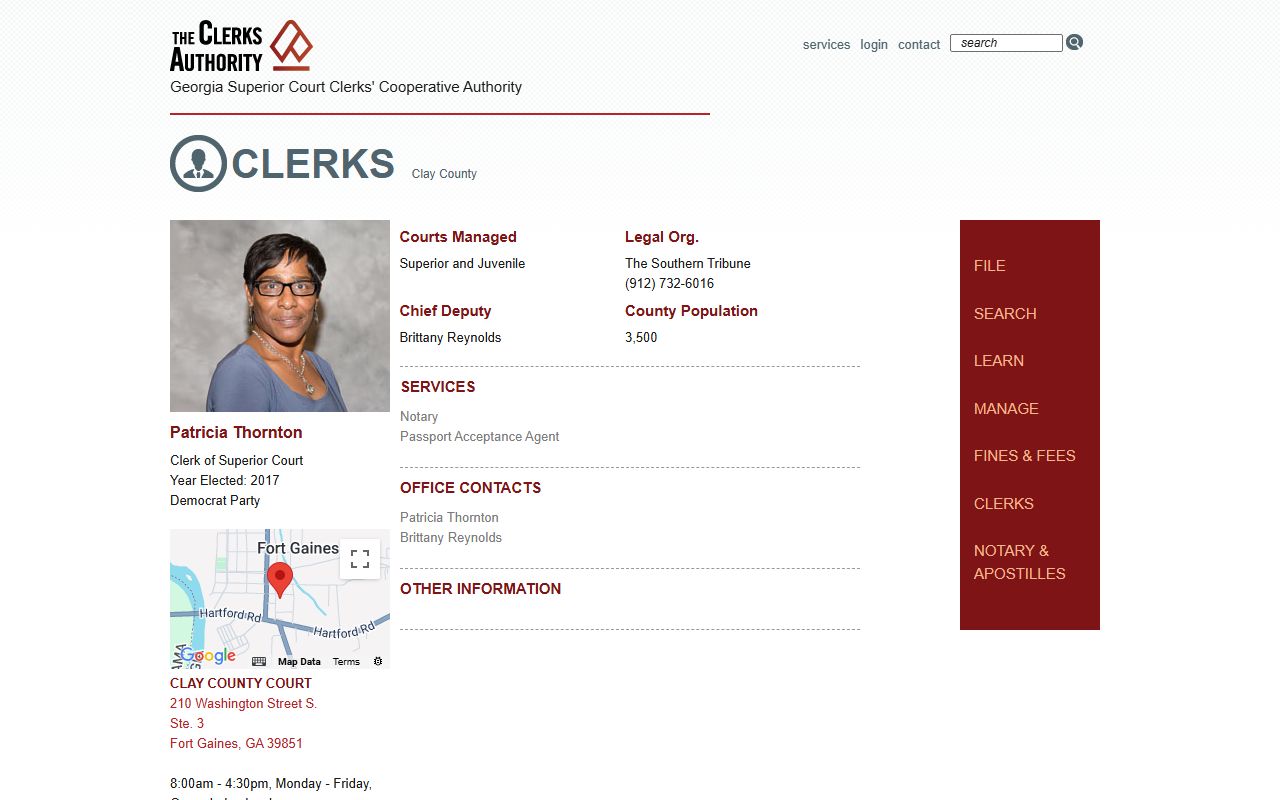
From this page, you can find the phone number, address, and links to search tools that include Clay County criminal court records.
| Superior Court Clerk |
210 S. Washington Street Fort Gaines, GA 39851 Phone: (229) 768-2631 |
|---|---|
| Office Hours | Monday through Friday, 8:30 AM - 5:00 PM |
| Judicial Circuit | Pataula (Clay, Early, Miller, Quitman, Randolph, Seminole, Terrell) |
Note: Clay County shares its judicial circuit with six other southwest Georgia counties, so judges and prosecutors rotate between courthouses.
How to Search Clay County Criminal Records
The simplest way to search for criminal court records in Clay County is to call or visit the clerk office in Fort Gaines. Give them a name or case number. Under O.C.G.A. § 50-18-70, criminal court records in Georgia are public. Anyone can ask to see them. You do not need a reason. The clerk must respond within three business days. Copy fees run $0.10 per page. The first 15 minutes of search time are free under O.C.G.A. § 50-18-71.
You can also mail a written request to the clerk at 210 S. Washington Street, Fort Gaines, GA 39851. Include the person's full name, date of birth, and case number if you have it. Clay County is very small, so the staff often knows the cases well. Most requests get turned around fast. If you are searching for a case that might have been filed in a nearby county instead, the clerk can sometimes point you in the right direction.
To search criminal records in Clay County, bring or include:
- Full name of the person
- Date of birth or approximate age
- Case number if known
- Whether it is a felony or misdemeanor charge
Criminal Cases in Clay County
Clay County Superior Court hears felony cases. These include drug charges, violent crimes, theft, and other serious offenses. Misdemeanor cases go through the State Court or Magistrate Court. Magistrate Court also handles preliminary hearings, warrants, and bond settings. The Pataula Judicial Circuit District Attorney prosecutes felonies across all seven counties in the circuit. Because the case volume in Clay County is low, court sessions may not happen as often as in larger counties. Check with the clerk for the next scheduled criminal court date.
Under O.C.G.A. § 50-18-72, some records stay out of public view during an active investigation. Once a case ends, most records become public. Basic docket info and court dates are available even for pending cases. Clay County sits on the Alabama border, so some cases involve out-of-state issues. If an arrest happened in Clay County, the case stays in the Georgia courts no matter where the person lives.
Clay County Criminal Records Online
Clay County does not have its own online court records portal. Use statewide tools instead. The Georgia Superior Court Clerks' Cooperative Authority indexes filings from all 159 Georgia counties. GSCCCA mainly handles real estate and lien records, but it can help you find the right clerk for criminal data in Clay County. A regular account runs $14.95 per month. Premium access is $29.95 per month. The E-Access to Court Records portal is another option that pulls case data from courts across the state. You need an account to search.
For your own criminal history, visit the Clay County Sheriff's Office and ask for a Purpose Code U report. The GBI Criminal History page has details on how this process works for all Georgia counties, including Clay. You can also call the GBI helpline at (404) 244-2639 option 3 with questions about your record.
Some criminal records can be restricted from public view under O.C.G.A. § 35-3-37. Arrests that did not lead to a conviction may qualify. Certain misdemeanor convictions are eligible after four years. Clay County residents start the process through the Pataula Judicial Circuit District Attorney for arrests on or after July 1, 2013. The fee is up to $50, and the process takes two weeks to 90 days. Georgia allows two misdemeanor conviction restrictions per person. Serious violent felonies and sex offenses cannot be restricted. Time-expired restrictions may happen automatically if no final disposition reaches the Georgia Crime Information Center within the set time frames.
Cities in Clay County
All criminal cases from towns in Clay County go through the Superior Court or State Court in Fort Gaines. The courthouse on Washington Street handles all felony and misdemeanor filings from across the county.
Fort Gaines is the county seat and main town. Bluffton is another small community in the county. Criminal cases from all areas within Clay County are handled at the courthouse in Fort Gaines.
Nearby Counties
These counties border Clay County. If you are not sure which county handles a criminal case, check the address where the arrest took place. Criminal cases must be filed in the county where the alleged crime occurred.